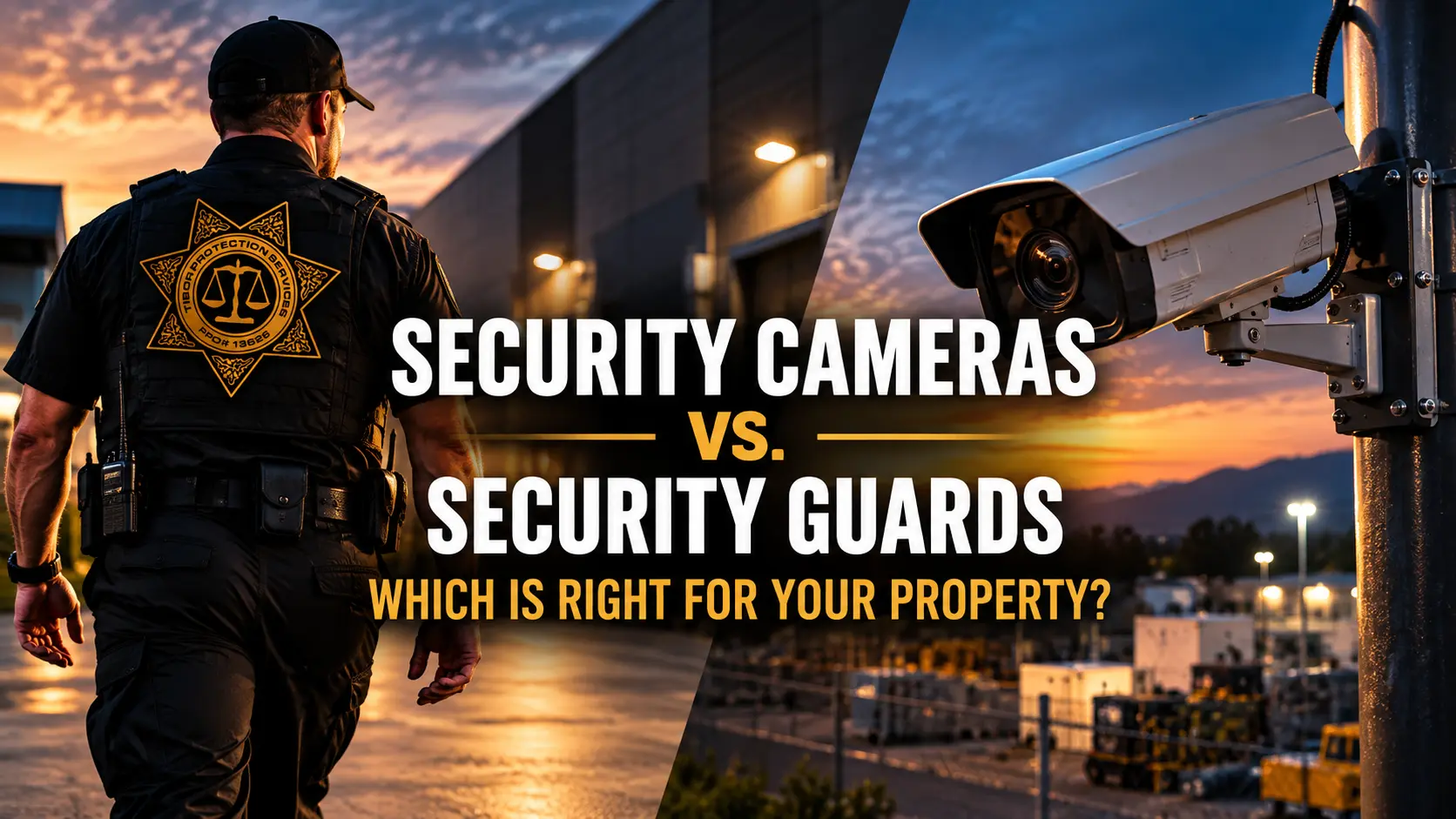
When businesses begin evaluating their security needs, one of the first questions is often:
Do we need security cameras or security guards?
It sounds like a simple either-or decision. In reality, the right answer depends on what you’re protecting, where the vulnerabilities are, when the property is most at risk and what needs to happen when a potential threat is detected.
A camera can see an area around the clock. A trained security officer can assess a situation and respond to what’s happening in real time.
For many commercial properties, the strongest security strategy isn’t choosing one over the other.
It’s determining how people and technology can work together.
At Tibor Protection, that’s an important part of how we approach security: identifying the risks first, then building the right combination of personnel, monitoring and technology around the property.
What Security Cameras Do Well
Modern surveillance systems provide businesses with capabilities that weren’t possible with traditional security alone.
Properly positioned cameras can continuously monitor entrances, parking lots, equipment yards, perimeters, restricted areas and other vulnerable locations.
Depending on the system, surveillance technology can help provide:
- Continuous visibility across multiple areas
- Recorded evidence of incidents
- Monitoring of remote or difficult-to-staff locations
- Detection of suspicious activity
- Documentation for investigations and incident review
- Expanded coverage without placing an officer at every location
For large properties and remote assets in particular, technology can dramatically extend the area that a security operation can monitor.
Tibor’s own security model uses advanced communication, tracking and sensor technology together with 24/7 dispatching and monitoring personnel to help direct guards and first responders toward potential security breaches.
But cameras have an important limitation.
Seeing something happen isn’t the same thing as responding to it.
That’s where trained security personnel become especially important.
What Security Guards Do Well
A professional security officer brings something technology cannot completely replace: human judgment.
An experienced officer can recognize unusual behavior, interact with people, control access, investigate suspicious activity and respond as a situation develops.
Security officers may also provide a highly visible deterrent. Their presence tells potential trespassers, thieves and vandals that the property is actively protected.
Depending on the site, security personnel can assist with:
- Access and gate control
- Property patrols
- Incident response
- Employee and visitor safety
- Restricted-area enforcement
- Identification of suspicious activity
- Documentation and reporting
- Coordination during emergencies
Training matters here.
Tibor emphasizes that its officers receive training appropriate to the sites they serve and that prevention and deterrence are central to its approach—not simply waiting for an incident to escalate.
Where Cameras Alone Can Fall Short
Installing cameras can create a sense that a property is protected simply because activity is being recorded.
But consider this scenario:
A camera records someone entering an equipment yard at 2:00 a.m.
The video may be valuable tomorrow.
But what happens tonight?
If nobody is monitoring the system, receiving an alert or responding to the activity, the camera may primarily document the loss rather than help prevent it.
This distinction is particularly important for properties containing valuable equipment, copper, vehicles, materials or other assets that can disappear quickly.
Tibor has used wireless sensors connected to its 24/7 monitoring operation to provide around-the-clock notification of potential theft or loss in remote areas. Its system was originally designed to expand coverage at larger sites and allow personnel to respond more efficiently.
Where Guards Alone Can Fall Short
The opposite problem can happen with guard-only security.
One person can only physically be in one place at a time.
On a large industrial property, construction site, equipment yard or multi-acre facility, an officer may be patrolling one portion of the property while activity occurs somewhere else.
Technology can become an extension of that officer.
Sensors, cameras, communications and monitoring can provide visibility beyond the officer’s immediate physical location and help direct attention toward an area where something may be happening.
That’s one of the reasons Tibor’s approach integrates technology with personnel rather than treating the two as competing solutions. Its Smart Management system is designed to help monitoring personnel assist and direct on-site guards and first responders toward possible breaches.
The Better Question: What Does Your Property Actually Need?
Instead of asking:
“Cameras or guards?”
Start with:
“What are we trying to protect, and where are we vulnerable?”
A retail property has different risks than a construction site.
A government maintenance yard has different security requirements than a vacant commercial building.
A remote utility site may need an entirely different approach than a facility with employees and visitors arriving throughout the day.
A proper security assessment should consider things like:
Property size and layout. How much territory needs to be monitored?
Operating hours. Is the greatest exposure during business hours or overnight?
Access points. How many gates, doors, driveways or uncontrolled entry points exist?
Asset value. What could be stolen, damaged or disrupted?
Response requirements. What needs to happen when suspicious activity is detected?
Existing security. What systems are already in place, and where are the gaps?
Location. Is the property staffed, isolated, temporary or difficult to monitor?
Only after understanding those factors does it make sense to determine the right combination of security measures.
Why Layered Security Can Be More Effective
For many commercial properties, the answer isn’t adding more of one security measure.
It’s creating layers.
A layered strategy might use surveillance technology to maintain visibility, sensors to identify activity, monitoring personnel to evaluate alerts, and trained security officers or responders to take action when necessary.
Each layer has a different job.
Technology helps extend visibility.
Monitoring helps identify what deserves attention.
Security personnel provide judgment and physical presence.
Response procedures determine what happens next.
When those components communicate with one another, the result can be a security operation that’s both more effective and more efficient.
Tibor describes its mission as providing customized, technology-driven security solutions designed to protect assets, maintain operational continuity and reduce risk.
So, Which Is Better: Security Cameras or Security Guards?
Neither is automatically better.
The right solution depends on the property.
Some businesses may need primarily technology and monitoring.
Others may require a visible officer presence.
High-risk or complex properties may benefit most from combining security personnel with surveillance, detection, monitoring and response.
The goal shouldn’t be to purchase the most cameras or hire the most guards.
The goal is to create the right security strategy for the actual risk.
Build Security Around Your Property—not a Generic Package
Every property has different vulnerabilities.
Tibor Protection develops customized security strategies using professional security personnel and advanced technology to help organizations protect people, property and critical assets. Its services include solutions such as remote asset protection, mobile surveillance, long-range detection, security officers, patrol services, access control, alarm response and security consulting.
If you’re unsure whether your property needs security officers, surveillance technology—or a combination of both—start with the property itself.
Let Tibor Protection evaluate the risks and help determine the right security approach for your operation.
Service… Whatever It Takes.
Tibor Protection
(909) 864-4650